




Ventilation - Angel and Demon in the fight with Covid-19
At this time we need all the efforts and resources available to manage this Covid-19 pandemic on all fronts as effectively as possible. Measures must be taken now, as far as possible, to prevent a very high spread rate.
Ventilation is the most important non-human component related to the spread of this virus inside buildings. A set of measures should be taken to help control the air path in buildings, in addition to standard hygiene measures, as recommended by the WHO.
Increasing the flow of air introduced / exhausted through ventilation systems.
In buildings with mechanical ventilation systems, extended operating time is recommended. Replace system malfunctions so that rated flow ventilation starts at least two hours before the building operation program begins. In the case of on-demand controlled ventilation systems, change the CO2 concentration reference to a lower value of 400 ppm to ensure rated flow operation. Keep the ventilation system on 24/7, with low ventilation rates (but not off) when people are not in the rooms. In buildings that have been released due to the pandemic (some office buildings or educational buildings) it is not recommended to stop ventilation, but to operate continuously at low flow.
The general advice is to introduce as much fresh air from outside as possible. The key aspect is the specific flow of fresh air introduced per person. If, due to the intelligent use of work, the number of employees is reduced, do not concentrate the remaining employees in smaller areas, but maintain or increase the social distance (physical distance of at least 2-3 meters between people) between them to promote the cleaning effect by ventilation.
Ventilated vents should always be switched on 24/7 and make sure that depression is created, especially to avoid oral fecal transmission.
Frequent use of natural ventilation through windows
The general recommendation is to avoid crowded and poorly ventilated spaces. In buildings without mechanical ventilation systems, the active use of operable windows is recommended (much more than normal, even when this causes a certain thermal discomfort). In these buildings, opening windows is the only way to stimulate air exchange flow. You can open the windows for about 15 minutes when entering the room (especially when the room was previously occupied by others). This procedure is also recommended in buildings with mechanical ventilation, as ventilation through windows can be used to further increase ventilation.
Windows open to toilets with uncontrolled ventilation or mechanical exhaust systems can cause contaminated air to flow from the toilet to other rooms, which means that the ventilation starts to work in the opposite direction. Thus, the opening of the toilet windows must be avoided. If there is no adequate exhaust ventilation from the toilets and the opening of the windows cannot be avoided, it is important to keep the windows open in other spaces, in order to achieve cross-flows in the building.
Careful use of heat recovery systems
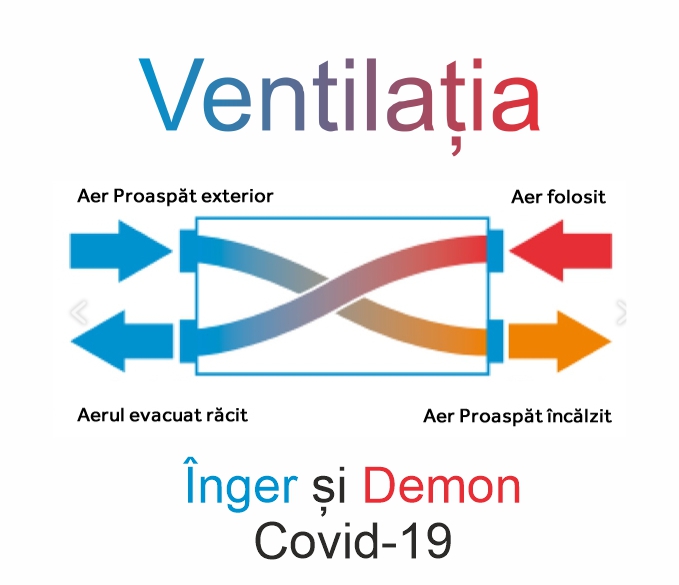
Under certain conditions, virus particles from the extracted air can re-enter the building. Heat recovery systems can carry the virus attached to the particles from the exhaust to the inlet through infiltrations.
Regenerated air-to-air heat exchangers (rotary exchangers, also called enthalpy wheels) can have considerable air infiltration in case of poor design and maintenance. In the case of properly functioning rotary heat exchangers, equipped with properly regulated condensate drainage systems, the degree of tightness is approximately the same as that of plate heat exchangers, being in the range of 1-2%. For existing systems, uncontrolled air infiltrations should be below 5% and should be compensated by increasing the rate of outdoor air ventilation, according to EN 16798-3: 2017. However, many rotary heat exchangers may not be installed correctly. The most common failure is that the fans have been installed so as to create a higher pressure on the exhaust side. This will cause infiltration of exhaust air into the introduced air. The degree of uncontrolled transfer (infiltration) of the extracted polluted air can in these cases be 20%, which is not acceptable.
Properly designed, installed and maintained rotary heat exchangers have been shown to have a transfer of almost zero particulate-related pollutants (including airborne bacteria, viruses and fungi), but the transfer is limited to gaseous pollutants, such as it would be tobacco smoke and other odors. Thus, there is no evidence that virus-carrying particles from 0.1 microns could be transported by air infiltration. Because the infiltration rate does not depend on the rotational speed, it is not necessary to stop the rotary recuperators. The normal operation of rotary recuperators facilitates the maintenance of higher ventilation rates. It is known that the transfer through air infiltration is higher at a low air flow, so higher ventilation rates are recommended.
Transmission of virus particles via heat recovery devices is not a problem when the HVAC system is equipped with an indirect fluid heat recovery system or other heat recovery device, which guarantees a 100% air separation between the exhaust and the inlet.
Air recirculation is not used
Virus particles from exhaust pipes can also re-enter a building when air handling units are equipped with recirculation caissons. It is recommended to avoid centralized recirculation during SARS-CoV-2 epidemics: it is recommended to close the recirculation flaps (through the automatic building management system or manually). If central recirculation is avoided, problems may arise with regard to the reduction of the cooling or heating capacity of the space. This must be accepted because it is more important to prevent contamination and protection of public health than to ensure thermal comfort.
Sometimes air handling units and recirculation caissons are equipped with exhaust air filters. This should not be a reason to keep the recirculation flaps open, as these filters do not normally filter out virus particles as they have standard efficiency (F4 / F5 or coarse ISO / ePM10 filter class). xxix and not HEPA efficiency.
Some systems (fan coils or induction units) work with local air circulation (at room level). If possible (there is no significant need for cooling), it is recommended that these systems be turned off to avoid recirculation of virus particles in the room (for example, when the rooms are normally used by more than one occupant). ). Fan coils have coarse filters that practically do not filter small particles with viruses but can still collect particles.
On the surface of the fan coil heat exchanger, the virus may be destroyed by raising the temperature to 60 ℃ for one hour or 40 ℃ for one day.
If it is not possible for the fan coils to be switched off, it is recommended that the fans run continuously to prevent the virus from settling in the filters and reactivating when the fans are put back into operation. During continuous operation of the fan coils, the virus will be removed by means of the exhaust ventilation system.


