




How to get energy efficiency in an office building
In this article we will find an example of expertise and execution in energy efficiency for an office building with an area of 2000 square meters, a building that was renovated and wanted to reach less than 15kWh / m2 / year for HVAC consumption. This renovation operation is one of the most efficient possible according to our information.
Building
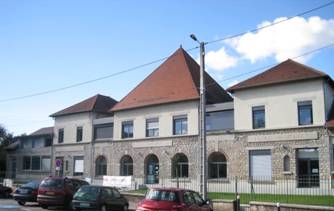
Figure 1
Minimize all requirements: heating, cooling and lighting
The losses under basic conditions are 65 kW or 32 W / m². Reinforced insulation from opaque walls - part of the insulation is made from the outside - leads to U coefficients around 0.25 W / m².K. In addition to 20 cm of mineral wool, the roof insulation is completed with 8 cm of wooden wool (U: 0.14 W / m².K). Here the goal was to strengthen the thermal inertia on the roof for comfort during the summer. Indeed, in addition to the low thermal conductivity, wood wool benefits from high mass density and thermal capacity. In summer, therefore, the heat from the roof is delayed by 5 to 7 hours, after the employees have already left the offices.
The windows are made of aluminum with double glazing filled with argon (Uw: 2 W / m².K). The surface is limited, covering on average 28% of the facade. This type of glass is a good compromise between a low solar factor (38%) to limit the solar contribution and high light transmission (70%) to promote natural lighting. The upper part of the interior walls has translucent panels that allow light to pass to the central walkways. To minimize energy consumption due to lighting, motion detectors have been installed in all walkways and service areas. It also controls HVAC in meeting rooms.
Installation of high efficiency equipment
Distribution terminals are refrigerated beam modules (figure 2). These are cassettes without fans that require neither filters nor condensate trays. Therefore, maintenance is quite simple. These boxes operate at high temperatures in summer and low temperatures in winter. The pretreated air from the central unit is introduced into the beams by means of motors that pass the air over the batteries by induction.
Air renewal losses are kept to a minimum: The air handling unit (AHU) is equipped with a high efficiency rotary heat exchanger with an efficiency of 80% (figure 3). The two fans are equipped with variable speed drive. The hygroscopic coating on the recuperator moistens the new air in winter and dries it in summer.
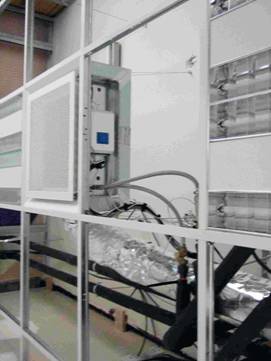
Figure 2
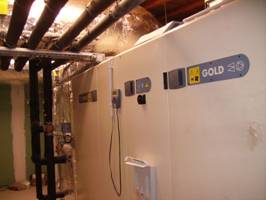
Figure 3
Hot and cold water is produced by two glycol / water heat pumps (figure 4). The heating power of each is 32.6 kW, the cooling power is 25.4 kW for the absorbed power of 7.2 kW (COP of 4.5 to 0 ° C / 35 ° C). A 9 kW electric heater is installed on the loop to prevent imperfection in the implementation of insulation in rehabilitation. The heat pumps are connected to a field of ten vertical geothermal probes, each penetrating to a depth of 100 meters (figure 5). The field size was based on 50 W / ml. In winter, water from the wells travels to the evaporators of the heat pump. In summer, the priority is given to the geo-cooling mode: the water from the wells provides the cooling battery of the AHU and the comfort modules, through a heat exchanger. In this case, the building is cooled without electric compression.
In the case of heat waves, the heat pump supports geo-cooling mode. The schematic diagram allows the evacuation of heat from the heat pump condenser to the vertical probes. Most circulation pumps are equipped with variable speed drives.
Finally, in addition to motion detectors, T5 type lighting is used. The cost of HVAC, with vertical geothermal probes, was 194 € HT / m².
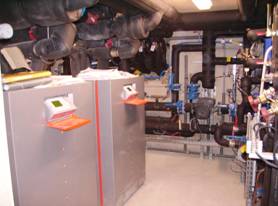
Figure 4
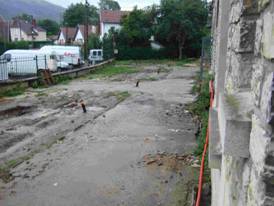
Figure 5
Remarkable result
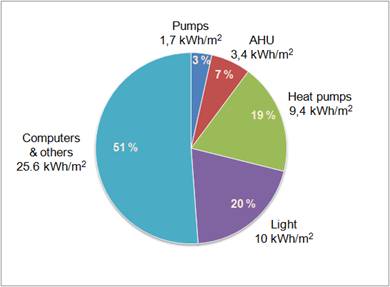
Final consumption for all uses reaches 50.1 kWh / m² / year. HVAC consumption accounted for less than a third of 14.5 kWh / m² / year (or 37.5 kWhEp). Other uses represent two thirds of consumption, respectively 36 kWh / m², ten of them being related to lighting (Figure 6)
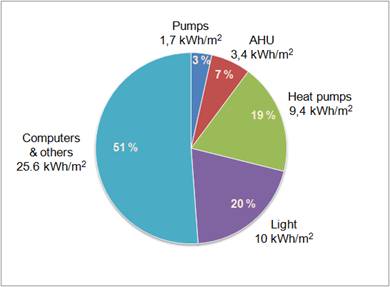
Figure 6
Heat pumps work in excellent conditions: an annual average is 4.2 and almost 4 when it includes the consumption of the pump that irrigates the geothermal probes. Despite the cold weather, no electricity was needed. Geo-cooling was able to provide the necessary cooling (figure 7).
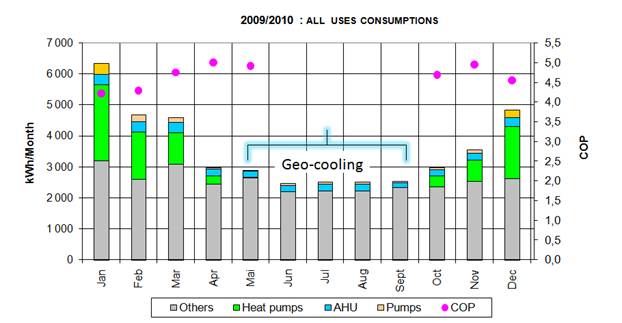
Figure 7
Table 1 shows the changes in the consumption rate between the first and second year of operation. The improvements come from better settings, especially in terms of programming intermittency, detection of airflow leaks in ventilation ducts, cleaning of clogged pump filters, lowering of condenser temperature, etc.
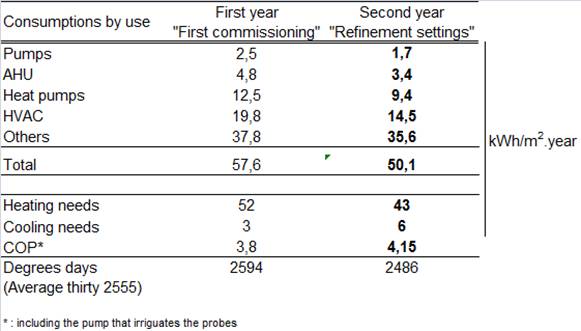
Table 1
"Class A" with regard to greenhouse gas emissions
When it includes lighting consumption, this site achieves a Class B and Class A energy label in terms of greenhouse gas emissions. A boiler solution and an air / water cooling unit (estimated performance at 95%) would also have been positioned in class B, but in class B in terms of greenhouse gas emissions. The vertical geothermal solution reduces CO2 emissions by two thirds.
Competitive operational budget
Geothermal solutions have a clear advantage over fossil fuels in terms of operating costs: MWh of heat from heat pumps is around 28 € / MWh without taxes included. With a gas boiler, it would have been close to 45 € / MWh without taxes included. Under these conditions, the costs of the power station are particularly low, reaching 5.6 € / m², with all uses included. The annual cost of HVAC is € 1.9 / m² by 1.3 for heat pumps. It is remarkable. This operation shows that geothermal solutions are an excellent source of eco-efficient energy.
Two difficult-to-achieve bars in primary energy were crossed: 40 kWhEp / m² / year for HVAC and 130 for all uses. Compared to the various studies conducted by EDF research and development and the current literature on this topic, in our opinion, this renovation project has the best performance in terms of energy eco-efficiency.
Conclusions
The building has undergone an exemplary refurbishment in terms of energy efficiency. This operation shows that, at reasonable costs (HVAC = 194 € / m²), we can reach less than 15 kWh / m².any for HVAC and less than 25 including lighting. In order to achieve these levels of consumption in other operations, it will be necessary, whenever possible, to apply the following eleven principles:
Insulate the walls at 0.25 W / m².K;
Insulate the roof at 0.15 W / m².K;
Install windows with 1.0 W / m².K, preferably for PVC;
Limiting the glazed surface to 30% of the vertical walls;
Systematization for lighting, installation of T5 tubes with presence detection;
Installation of a double flow AHU with rotary exchanger;
Choice of auxiliaries (pumps and fans) with variable electronic speed;
Installing - the cornerstone of all - thermodynamic machine with a COP close to 4 (body of water or vertical probes, depending on site constraints).
The technical points must be doubled with the following organizational measures:
Regular inspections;
Commissioning in the smallest details;
Energy monitoring at the beginning of winter.
We at E.E.B.C. we take into account all aspects related to the challenges of energy consumption of a building and we will always choose the best technologies and we will select only the appropriate equipment for each project.


